
Eco o Echos?
When eco-claims wash away what matters
by the Eco-lokohan team | 3 min. read
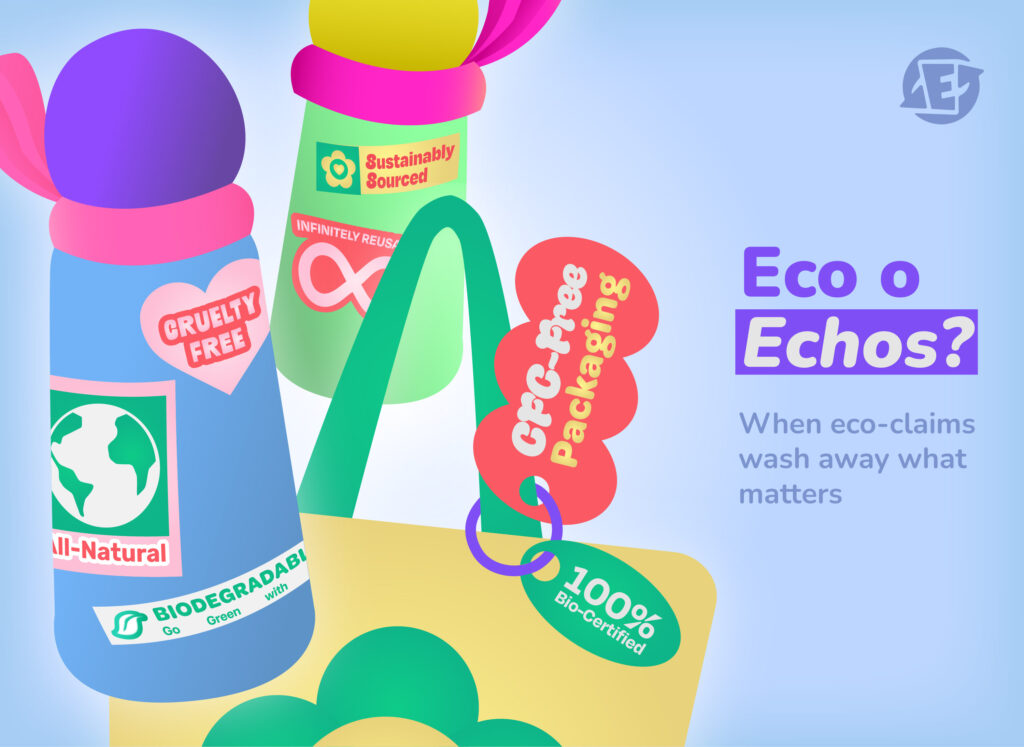
“Ang dami namang echos!” is something we often feel when faced with fine print or long labels on products. “Echos”, a Tagalog slang word for “nonsense”, refers to details we think are too technical or tiring to digest. These include nutrition facts, production details, or more relevantly – eco-labels and certifications. These tend to get lost in the “ka-echosan” when we’re on a shopping spree, where we barely have time to do more than scan labels. Besides, what we shrug off as ka-echosan seems trivial. However, in terms of eco-products, how much of the ka-echosan marketed to us is actually disguised nonsense in the form of greenwashing?

Greenwashing is a phenomenon in which brands fake or exaggerate how environmentally-friendly they actually are. A study by Yildirim (2023) points out six indicators: hidden trade-offs, no proof, vagueness, irrelevance, false labels, and the lesser of two evils. With a lack of strict regulations in the Philippines when it comes to green marketing & advertising, greenwashing is more common than you might think. In real life, these manifest in buzzwords such as natural, eco-friendly, bio-certified, sustainably sourced, and more, which make products seem eco-friendly, but lack supporting evidence. Moreover, a common marketing tactic you’ve probably encountered is when brands use numbers and percentages such as “100% natural” or “50% less carbon footprint”, but without proper supporting information. These common indicators tick the boxes of today’s greenwashing starter pack.
Even if you know about greenwashing, falling for its red flags is easier than you think. Both brands and consumers are caught up in a toxic cycle – brands use ka-echosan to build an eco-friendly image, and we buy into it because it makes us feel like we’re doing our part. In this cycle, brands and consumers fall guilty to the illusion of being green. In a research conducted by the Ecolokohan team, it was found that verifying product sustainability claims just isn’t a consumer’s priority. However, it is important to realize that consumption is never the primary solution to being eco-friendly.
To experience how greenwashing ka-echosans can possibly shape our habits, go with Eunice on her Christmas shopping journey as you help her choose her path by immersing yourself in the Eco-lokohan hypernarrative.

 © Eco-lokohan 2025
TEST